
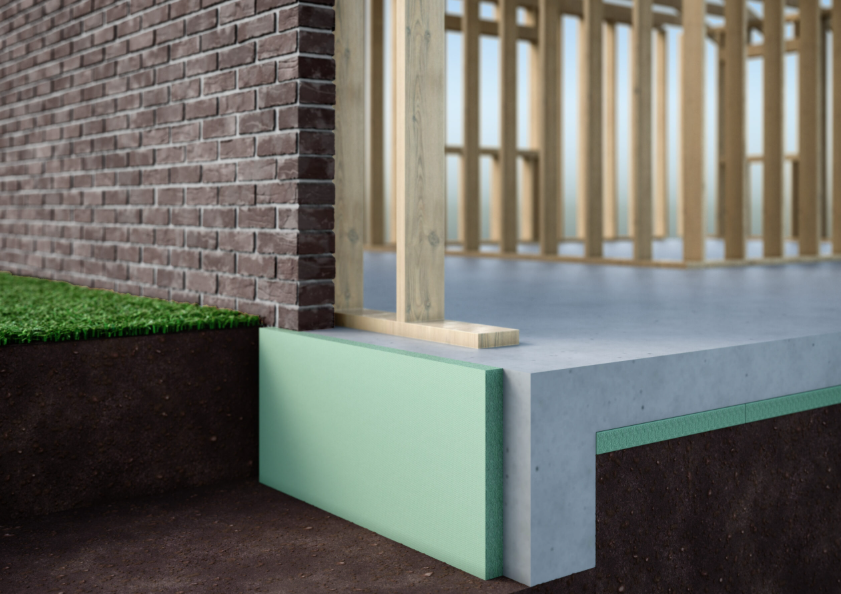
Concrete slabs are sold to homeowners as a stable, low-maintenance foundation. What rarely gets mentioned is that an uninsulated slab is essentially a slow heat exchanger — one that works against the home’s thermal comfort every single hour of every single day. Under slab insulation breaks that exchange. And the reason it stays off most conversations until something goes wrong is simple: it is invisible once the house is built, and invisible problems rarely get fixed proactively.
Cold Floors Are a Symptom, Not the Problem
When a floor feels cold in winter, the instinct is to add a rug or turn the thermostat up. Neither does anything about what is actually happening. An uninsulated slab is in direct thermal contact with the ground, which sits at a temperature well below what feels comfortable indoors. The slab surface reflects that ground temperature, and no amount of surface-level fixing changes it. Homeowners who have lived in a well-insulated slab home describe the difference not as warmth exactly, but as the floor simply not fighting the room anymore. That is the shift — the floor stops being an opponent.
Polished Concrete Is Gorgeous Until Winter
The appeal of polished concrete floors is real — the aesthetic is clean, the maintenance is minimal, and the material is durable. The part that gets left out of the design conversation is thermal performance. Without insulation beneath it, a polished concrete floor in a cold snap is genuinely unpleasant underfoot. Many homeowners offset this with hydronic heating embedded in the slab, which works — but the efficiency of that system depends entirely on whether the slab is losing heat downward. An uninsulated slab with hydronic heating is essentially warming the ground. An insulated one directs that warmth upward, into the room, where it is supposed to go. Under slab insulation is what makes hydronic heating as efficient as its reputation suggests.
Thermal Mass Only Works When Heat Has Nowhere to Escape
Concrete has genuine thermal mass. It absorbs heat during the day and releases it slowly at night, which in the right climate is a meaningful passive heating and cooling asset. But thermal mass only functions this way when the heat stored has somewhere to stay. In an uninsulated slab, heat absorbed during the day drains steadily into the ground rather than being released back into the room at night. The mass is there. The performance is not. Insulating beneath the slab is what converts concrete from a thermal drain into a thermal battery — and in Australian climates where daily temperature swings can be severe, that conversion has real, measurable impact on how comfortable a home feels without mechanical assistance.
Why the Wrong Material Causes Long-Term Failure
Not every insulation product is rated for sub-slab use, and this distinction matters more than most product specifications make clear. The insulation sitting beneath a concrete slab needs to bear the weight of the concrete itself plus everything built on top — furniture, people, structural loads — for the life of the building. Rigid extruded polystyrene boards are specified for this application because their compressive strength does not degrade under sustained load. Softer materials compress over time, losing thickness and R-value gradually — meaning the home slowly loses whatever thermal performance it started with. By the time the problem is detectable, the concrete has been poured over it for years.
The Question to Ask Before the Quote Is Signed
Builders price what they include in the scope. If under-slab insulation is not listed, it is not included — and once the slab is poured, the option is gone permanently. Retrofitting means demolishing the floor, which is a project that almost never happens because the disruption and expense are too significant. This is not about pressuring builders — it is about understanding that the design stage is the only stage where this decision is available. A direct question during the quoting process — “Is under-slab insulation in the scope, and if not, why?” — is the kind of question that separates a house built to perform from one built to pass inspection.
Conclusion
Under slab insulation is the kind of decision that disappears into the structure of a home and then quietly determines how that home feels for decades. It explains why two houses built in the same year, on the same street, with similar heating systems can perform so differently in winter. It is the reason some polished concrete floors are comfortable and others are not. It is the reason some slab-on-ground homes run hydronic heating efficiently and others run it expensively. Getting it right does not require a large investment in knowledge — it requires asking about it before the concrete is poured, when the answer can still change something.
