
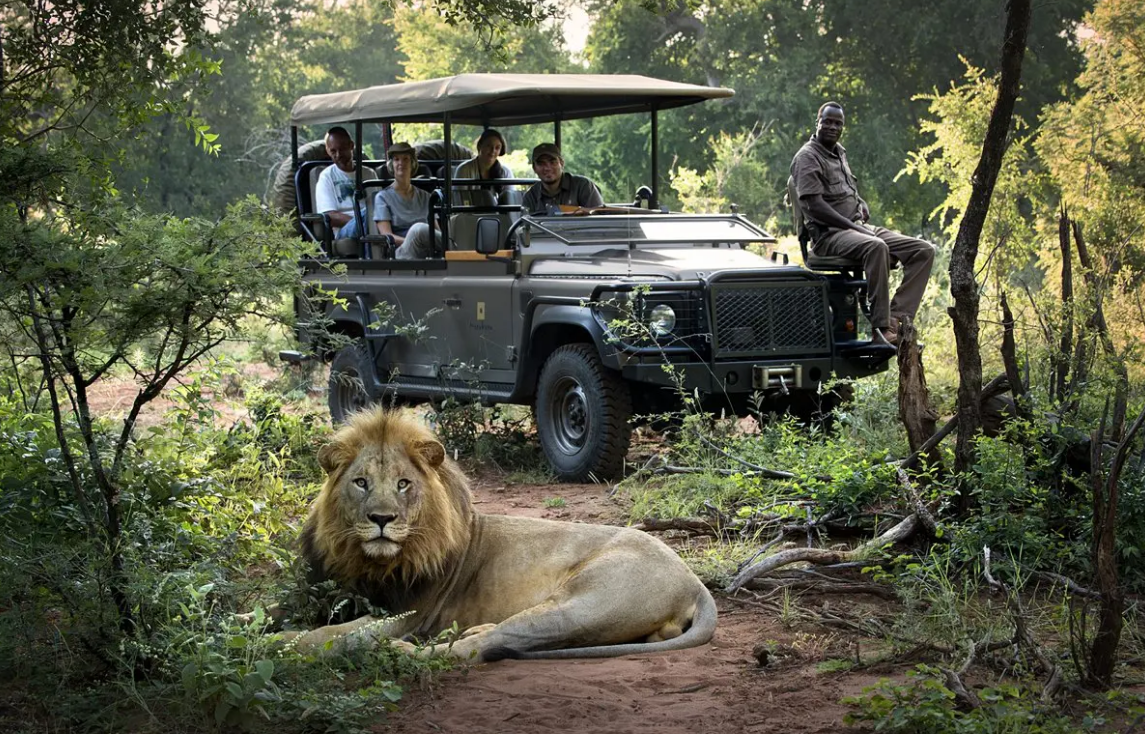
Southern Africa’s Safari destination does not ease you in gently. It drops you straight into something unfiltered, loud at night and startling at dawn, with no version of a safety net anywhere nearby. Most travel experiences involve some kind of curation between the visitor and the place. Here, that layer simply does not exist. The bush runs on its own schedule and its own rules, and travellers are just passing through on its terms. That feeling — of being genuinely peripheral to something vast — is what separates this region from every other wildlife destination people tend to compare it to.
Remarkable Wildlife
What surprises people is rarely what they expected to be surprised by. The famous animals are there, yes, but it is often a honey badger ripping into a termite mound with complete disregard for anything watching, or a pangolin curling into itself on a quiet dirt track, that genuinely stops conversation in a game vehicle. Wild dogs are another one. They are far less common than lions, hunt with a terrifying group intelligence, and carry a kind of energy that lions — for all their reputation — simply do not. Experienced rangers will often say that a wild dog sighting stays with people longer than almost anything else, and they are right.
Stunning Landscapes
The Okavango Delta does something rivers are not supposed to do. It turns away from the sea, floods inward, and transforms dry Kalahari scrubland into something almost impossibly alive. Namibia goes in the opposite direction entirely — ancient, bleached, barely touched by water at all. Deadvlei sits inside it like a place where time gave up, with dead trees standing white against burnt orange dunes, preserved perfectly because the air is too dry to allow decay. These are not landscapes that resemble anything familiar. They operate by different rules, and that is genuinely the point.
Best Travel Seasons
Dry season thins the vegetation and concentrates animals around water, making game drives more consistently productive. But the shoulder period, right as the rains begin to arrive, does something the dry season cannot. Storms stack on the horizon for hours before they break. The air before rainfall in the bush carries a smell — dusty and green at once — that is entirely its own thing and impossible to describe properly to someone who has not experienced it. Predators shift into higher activity as prey animals move and scatter. The bush becomes louder, faster, and far less predictable. For travellers willing to accept a little mud, the timing delivers something the dry season never quite manages.
Conservation Efforts
Southern Africa’s safari destination has quietly become one of the more serious examples of conservation and tourism working without cancelling each other out. Anti-poaching operations in Botswana run across unfenced wilderness areas larger than most people can mentally picture, using tracking tools borrowed from military applications. In Zimbabwe, species that disappeared from certain regions within living memory have been successfully reintroduced through concession-funded programmes. The link between visitors arriving and animals surviving is not a marketing line here. It holds up when examined closely.
Cultural Richness
San guides from the Kalahari read the land in ways that take a long time to appreciate properly. A beetle’s path across sand can indicate underground moisture. A particular bird call shifts meaning depending on the time of day. This is not inherited folklore kept alive for tourism — it is functional knowledge, refined across countless generations, that still produces accurate results in the field. Lodges that integrate this into the actual safari experience rather than staging it separately tend to offer something measurably different. Guests come away having learned something rather than simply having observed something.
Accommodation Options
Some tented camps sit in areas where elephant herds move through after dark, passing between tents as they always have, unbothered and unhurried. The tents do not stop this from happening. They are not designed to. Certain camps cut power deliberately past a set hour, leaving the sky fully dark overhead — and in areas this far from city light, the night sky becomes something that genuinely requires a moment to adjust to. The accommodation is built around the surroundings rather than against them, and that design choice changes the entire texture of the experience.
Conclusion
Southern Africa’s Safari destination does not rely on scale alone to make its impression. It works through accumulation — a tracker pressing a hand to dry ground, a wild dog pack regrouping at dusk, the specific silence that settles over the bush just after an elephant moves through camp. None of it is staged. None of it repeats exactly. Travellers who come expecting a highlight reel tend to leave with something quieter and more durable than that, a genuine shift in how they think about wild places and what it means to move through one carefully.
