
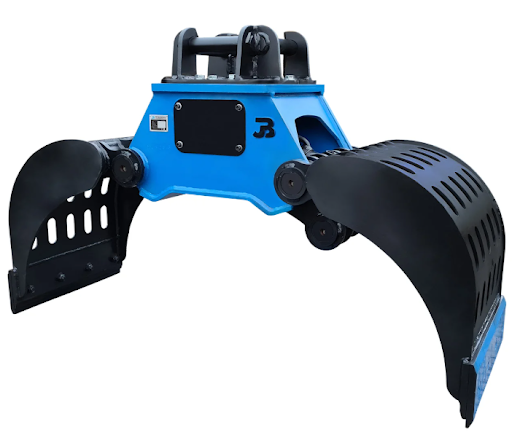
There’s a quiet frustration that runs through a lot of job sites. Operators watch their excavators do half the work they’re capable of, simply because the wrong attachment is sitting on the arm. The bucket gets used for everything by default, even when it’s genuinely the wrong tool for the job. For anyone who has looked seriously at excavator grabs for sale, what often surprises them isn’t the variety of machines on offer — it’s the realisation of how much productive capacity they’ve been leaving untouched.
The Bucket Problem
A standard bucket is brilliant at digging. It’s not brilliant at much else. When operators try to use it for sorting timber, managing demolition debris, or handling irregular waste loads, they’re fighting the tool rather than working with it. Material spills. Re-handling time climbs. The site’s rhythm slows down, and nobody quite pinpoints why. The bucket wasn’t designed for precision — it was built for volume, and that distinction matters far more than most people realise until a project starts bleeding time.
What Grabs Actually Do Differently
A grab gives the excavator something a bucket never can — a sense of grip. It reaches into a pile, selects a load, and places it with accuracy that changes how work flows on site. On a timber operation, logs get stacked cleanly without repeated attempts. On a demolition job, steel reinforcement gets pulled away from concrete without stopping to manually separate materials. That’s not a marginal gain. That’s a different way of working altogether.
The Rotating Grab Advantage
One detail that rarely gets enough attention is the rotating grab. A fixed grab moves material in line with the machine’s orientation, which sometimes means the entire excavator needs to reposition just to place a load correctly. A rotating grab removes that problem entirely. The operator spins the load into alignment without shifting the machine. It sounds minor until you’re working in a confined space or trying to hold a tight cycle time, and then it becomes one of those things you can’t imagine working without.
Matching the Grab to the Job
Not every excavator grab suits every environment. In scrap metal yards, an orange peel grab handles tangled, irregular loads that a clamshell would struggle to close around cleanly. In bulk recycling operations, a clamshell’s tighter closure keeps spillage down and cuts re-handling costs. Operators who treat all grabs as interchangeable tend to run into the same frustrations they were trying to escape. The attachment still isn’t quite right, and the benefits never fully arrive.
Carrier Matching Is Just as Important
There’s a tendency to focus entirely on the grab itself and treat carrier matching as a secondary concern. That’s a mistake. An undersized carrier running an oversized grab creates instability and accelerated wear that quietly shortens the working life of both the machine and the attachment. Getting the pairing right from the beginning isn’t just good practice — it’s what separates a sound investment from an expensive lesson.
Maintenance That Actually Matters
Once a grab enters regular service, wear concentrates in predictable places — jaw tips, pivot points, and hydraulic seals. Operators who check these areas consistently catch problems before they become full replacements. On high-volume sites, even slight jaw misalignment starts dropping material and slowing cycle times in ways that get blamed on the operator long before anyone inspects the attachment. Staying ahead of wear patterns is straightforward work, but it makes a genuine difference to how long a grab earns its keep.
Making the Right Procurement Decision
Buying a grab takes more thought than many operators initially expect. Lead times, warranty terms, parts availability, and after-sales support vary significantly between suppliers. A grab that costs less upfront but lacks local service backing becomes a far heavier expense the moment something needs replacing mid-project. Excavator grabs sourced through suppliers with solid Australian service networks tend to hold their value better over time — not necessarily because the hardware differs, but because getting back to work quickly when something goes wrong is worth a great deal on any live project.
Conclusion
The real argument for excavator grabs for sale isn’t built on a features list. It’s built on understanding where familiar tools fall short and what becomes possible when the attachment actually suits the task. Grabs bring precision to work that buckets handle poorly, reduce manual handling risks that regulators are paying closer attention to, and — when matched properly to both machine and application — deliver consistent gains that compound across a long project. The operators who get the most from them treat the selection process as seriously as they treat the machine purchase itself. That mindset is usually the difference between a good result and a great one.
