
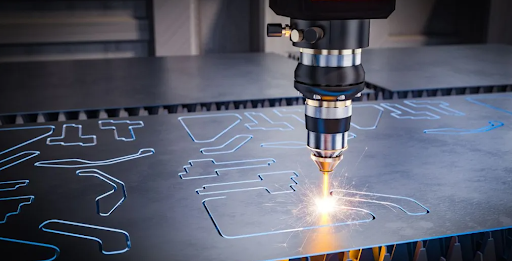
Most fabrication problems don’t announce themselves during the cutting stage. They show up later — during assembly, when mating parts don’t sit flush, or during finishing, when edge inconsistencies that looked minor under workshop lighting become obvious under a coat of paint. The cutting decision made early carries consequences that compound downstream. That’s the real conversation worth having about why a quality laser cutting service in UK matters far beyond the cut itself.
Edge Quality Has a Downstream Cost
Plasma cutting leaves a heat-affected zone wide enough to alter material properties along the cut line. Waterjet produces a slight taper on thick sections that needs compensating for in tight-fit applications. Mechanical sawing leaves striations that trap contaminants in food-grade and medical environments. Laser cutting produces a narrow kerf with a heat-affected zone so controlled that most applications need no secondary treatment at all. That’s not a marginal difference. It’s hours of post-processing labour removed from every single job.
What Complexity Costs in Other Processes
In mechanical cutting, design complexity translates directly into time and tooling expense. Every internal radius tighter than the tool diameter requires a different approach. Every fine detail adds setup time. Laser cutting breaks that relationship entirely. A design with intricate nested geometry takes the same beam path time per metre of cut as a simple rectangle. The complexity penalty that forces designers to simplify parts for manufacturability doesn’t exist here. Parts get made as designed — not as manufacturing constraints reluctantly allow.
Material Knowledge Is the Real Differentiator
Knowing a machine can cut brass is different from knowing how brass actually behaves when it gets cut. Brass work-hardens differently from mild steel. Certain aluminium alloys reflect the beam at lower power settings in ways that damage optics if the operator isn’t accounting for it. Acrylic requires different assist gas than metals or the edge finish clouds rather than polishes. A serious laser cutting service in UK carries that material knowledge as genuine operational expertise — not as reference material looked up between jobs, but as the kind of understanding that stops problems before they ever reach the part.
Repeatability Isn’t the Same as Accuracy
A process can produce accurate parts without being repeatable. Manual processes demonstrate this regularly. A skilled operator hits tolerance on the first part, then drifts across a run as conditions shift and fatigue sets in. Laser cutting is repeatable in the way that programmed processes are — the variables that cause drift in manual operations simply aren’t present. The programme runs identically on each part. For manufacturers supplying into industries where batch consistency gets audited rather than assumed, that distinction carries weight that accuracy alone doesn’t.
Why Turnaround Speed Is Structural
Short lead times in laser cutting aren’t achieved by rushing. They’re structural to how the process works. No hard tooling gets manufactured between order and first cut. No fixtures get built from scratch for each new job. A verified design file and correct material on the bed is genuinely all the process needs to begin. Laser cutting service providers can respond to short-notice requirements without the quality trade-offs that other processes impose when accelerated — because speed is built into the method rather than achieved by compressing steps that shouldn’t be compressed.
Where Other Methods Fail Visibly
Cutting thin sheet mechanically means applying force to material that deflects under force. The results show — bowing, edge distortion, stress marks that affect how the part behaves when formed or welded later. Laser cutting touches nothing. The beam removes material without contact pressure, which means thin gauges come off the machine flat and undistorted. For enclosure work, decorative metalwork, and electronic component manufacture, this isn’t a technical footnote. It’s the reason laser cutting gets specified over every alternative without much debate.
Conclusion
Fabrication decisions made at the cutting stage ripple through every process that follows. A professional laser cutting service in UK removes the downstream problems that originate at the cut — edge defects, dimensional drift, distortion in thin material, and complexity penalties that force design compromises. For UK manufacturers working to tight specifications across demanding applications, precision laser cutting doesn’t just deliver better parts. It removes the hidden rework that conventional methods quietly build into every job.
