
The Indian financial landscape has undergone a seismic shift over the past few years. With the democratization of technology and the rise of mobile trading apps, the Indian stock market has seen a record breaking surge in retail participation. However, for many, the market remains a daunting realm of complex terminology and volatile charts. Understanding the basics is not just about learning how to trade, it is about building a foundation for long term wealth creation and financial independence. This guide aims to deconstruct the stock market into digestible concepts for every aspiring investor.
What Exactly is the Stock Market?
At its most fundamental level, the stock market is a centralized platform where shares of publicly listed companies are issued, bought, and sold. When a company wants to expand its operations, launch new products, or pay off debt, it may choose to go public through an Initial Public Offering (IPO). Once the company is listed, its shares represent units of ownership.
As an investor, buying a share means you own a tiny portion of that corporation. Your fortune is now linked to the company’s performance. If the company thrives, the demand for its shares increases, driving the price up and resulting in capital appreciation for you. Conversely, if the company underperforms, the share price may drop. Beyond price changes, many established companies also distribute a portion of their profits to shareholders in the form of dividends.
The Pillars of the Indian Equity Market: NSE, BSE, and Indices
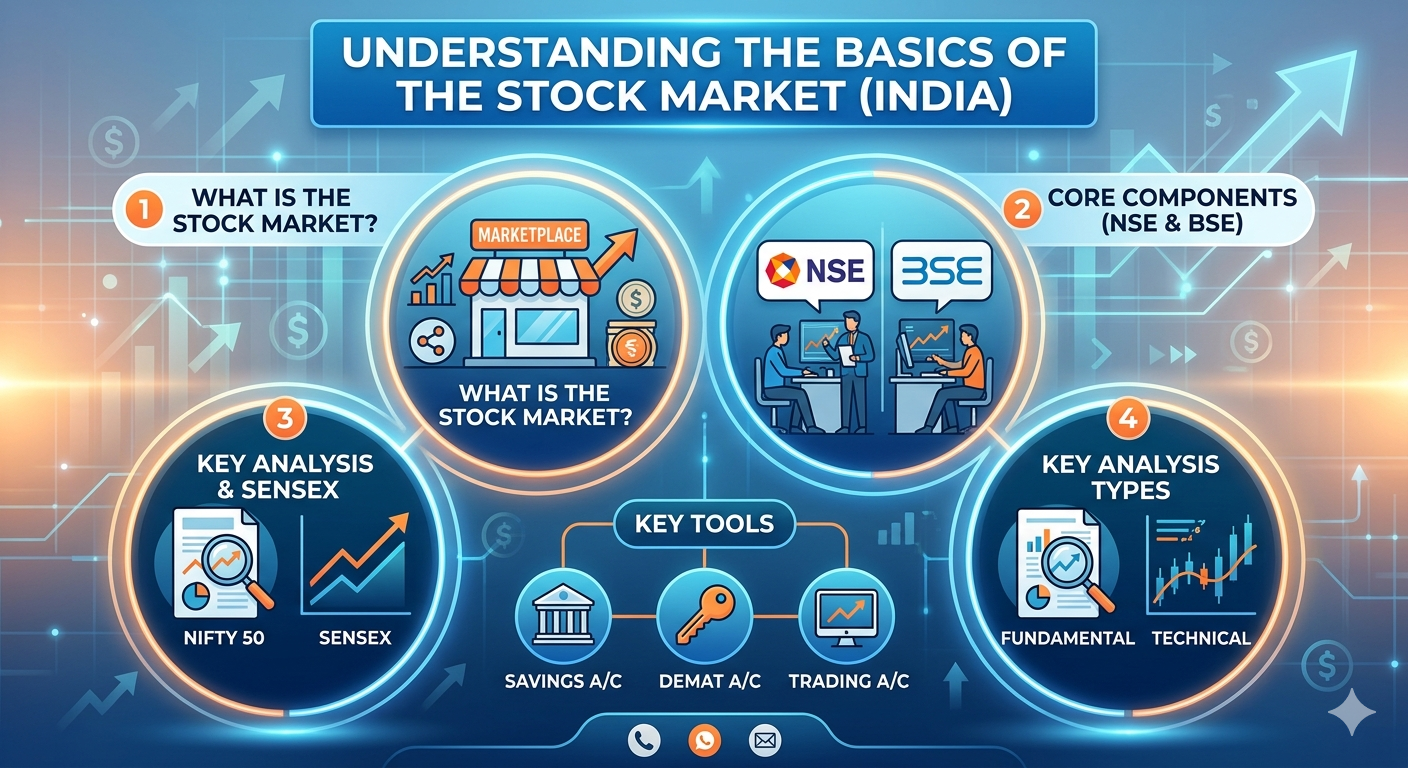
To operate effectively in the Indian context, one must understand the infrastructure that supports trading. India primarily operates through two major stock exchanges:
1. Bombay Stock Exchange (BSE): Established in 1875, it is Asia’s oldest stock exchange. It is home to the Sensex, an index comprising 30 of the largest and most financially sound companies in India.
2. National Stock Exchange (NSE): The leading modern exchange in India, known for its advanced fully automated screen-based trading system. Its flagship index is the Nifty 50, which tracks the performance of the top 50 companies across various sectors.
Indices like the Nifty 50 and Sensex serve as the thermometer of the economy. When you hear that the market is up, it usually means these benchmarks have gained value, reflecting overall positive sentiment in the business environment.
The Three-Account Framework: Your Entry Point
Starting your investment journey requires more than just a bank account. In India, the Three-in-One account structure is the standard:
• Savings Account: This is where your liquid cash resides. You transfer money from here to your trading account to buy stocks.
• Demat Account: Short for Dematerialized, this account acts like a digital locker. It holds your shares in electronic format, eliminating the need for physical share certificates.
• Trading Account: This is the interface provided by your broker. It is used to place Buy or Sell orders on the stock exchange.
Fundamental vs. Technical Analysis: Choosing Your Strategy
Success in the market is rarely the result of guesswork. Investors generally follow two main schools of thought:
Fundamental Analysis: This is the study of a company intrinsic value. It involves analyzing financial statements, evaluating management quality, and understanding the industry competitive landscape. Platforms like Equitylogy.in specialize in providing these deep dives, helping investors identify quality stocks that are built to last.
Technical Analysis: This approach focuses on historical price action and volume data. Technical analysts use charts and mathematical indicators to predict short-term price movements. While fundamental analysis tells you what to buy, technical analysis often helps you decide when to buy.
Risk Management and the Power of Diversification
The stock market is inherently volatile. Prices can fluctuate based on global events, government policy changes, or quarterly earnings reports. The most effective shield against this volatility is diversification. As the old adage goes, don’t put all your eggs in one basket.
A well-diversified portfolio includes stocks from different sectors – such as Banking, Information Technology, Healthcare, and Consumer Goods. If one sector faces a downturn, your gains in another sector can help balance the overall portfolio performance.
The Excitement of IPOs and Market Awareness
Initial Public Offerings (IPOs) are often the entry point for many new investors. An IPO allows you to invest in a company at its “birth” on the public exchange. However, IPO investing requires careful study of the Draft Red Herring Prospectus (DRHP). Monitoring grey market premiums (GMP) and subscription levels on trusted financial portals is crucial before committing capital to a new listing.
Conclusion: The Long-Term Perspective
The stock market is a powerful engine for wealth creation, but it rewards patience and discipline over greed and speculation. For a beginner, the goal should be “Time in the Market” rather than “Timing the Market.” By staying informed through reliable sources like Equitylogy, continuously learning, and maintaining a long-term horizon, anyone can navigate the complexities of the Indian stock market and secure their financial future.
Author Information
Name: Amit Kumar
Professional Summary: Amit Kumar is a digital marketing expert, entrepreneur, and the visionary founder of Equitylogy.in. With over 10 years of experience in SEO and financial content strategy, Amit has dedicated his career to making the Indian stock market accessible to everyone. He specializes in technical analysis, IPO research, and creating data-driven content that empowers retail investors to make smarter financial decisions. Under his leadership, Equitylogy has become a trusted name for real-time market updates and in-depth financial education.
Website: https://equitylogy.in/
