
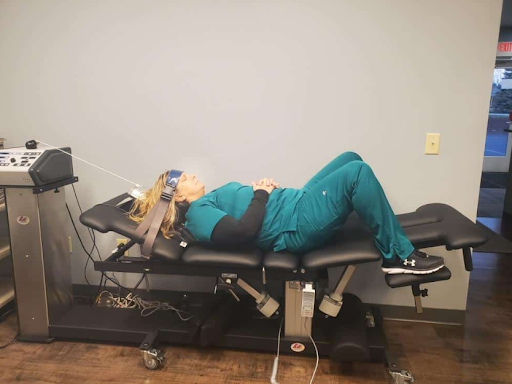
There is a reason back pain keeps coming back. It is not bad luck, and it is not that the body heals slowly. It is that most treatments are aimed at the wrong target. Painkillers quieten the signal but leave the source untouched. Stretching lengthens the muscles around the problem without ever reaching it. Even physiotherapy, which helps enormously with movement and strength, rarely changes what is happening inside the disc itself. Nobody explains this clearly to patients, which is part of why so many people spend years rotating through treatments without ever properly recovering. A spinal decompression machine works differently — not because it is newer, but because it is aimed at the actual source.
The Disc Cannot Feed Itself
Spinal discs are the only structures in the body that have no blood supply at all. That single fact changes everything about how they deteriorate and how they can recover. Because blood cannot reach them, they cannot use the standard repair process the rest of the body relies on. Instead they depend on a pressure exchange — load and unload, compress and release — to pull nutrients in from the surrounding tissue. Every time the spine moves properly, that exchange happens. Every hour spent sitting still in a fixed position, it does not. What accumulates over years of desk work and limited movement is not just stiffness. It is progressive dehydration of living tissue that has no other way to stay healthy. That is the underlying condition that most people with chronic back pain are actually dealing with, usually without anyone having explained it to them.
Why Muscle Guarding Defeats Simple Traction
The older version of spinal traction pulled the spine in a straight, sustained line. It seemed reasonable. The trouble is that a prolonged, unbroken pull triggers an automatic protective response from the deep muscles surrounding the spine — they contract hard to stabilise the vertebrae against what the nervous system reads as a destabilising force. So the traction pulls, the muscles pull back, and the disc space barely moves. The treatment was working against the body’s own protective reflexes the whole time.
The Oscillation Principle
A spinal decompression machine bypasses that problem by never holding tension long enough to trigger the guarding response. It applies a gentle distraction force, then releases, then applies it again — in a slow, repeating cycle the nervous system accepts rather than resists. The paraspinal muscles stay relaxed. The vertebrae actually separate. And inside that separation, intradiscal pressure drops to a point where the fluid dynamics reverse — instead of pressure pushing outward, the disc begins drawing inward, pulling water, nutrients, and oxygen from the surrounding tissue. Disc rehydration, done mechanically, in a way no stretch or exercise can produce.
Sciatica Responds for a Specific Reason
Most patients assume decompression will help their back pain and are surprised when the shooting leg pain improves first. The reason involves what happens to herniated disc material under negative intradiscal pressure. When a disc bulges or herniates, the protruding material presses on a nearby nerve root, which is where the radiating pain originates. The retraction effect created by spinal decompression machine therapy draws that material back inward, reducing the direct compression on the nerve. It does not happen instantly or completely in every case. But the direction of the mechanism is specific and logical, which is why sciatica patients so often notice changes in their leg symptoms before anything else shifts.
The Post-Session Window
Clinicians who understand disc physiology pay close attention to what patients do in the hours following a session. The disc is most receptive to rehydration immediately after decompression, when intradiscal pressure has been reduced and the tissue is primed to absorb. Prolonged sitting during that window compresses the disc again and interrupts the process. Patients who stay active, drink enough water, and follow any prescribed movement protocols between sessions recover measurably faster than those who do not — not because decompression worked better, but because they allowed the disc to complete the process rather than reversing it.
Conclusion
The insight that changes how people approach chronic back pain is a simple one: disc tissue cannot heal through rest because rest does not restore what discs need to survive. A spinal decompression machine restores it mechanically — driving fluid and nutrients back into avascular tissue that has no other route to recovery. For patients who have been managing rather than healing, understanding that mechanism is often what finally makes the difference.
