
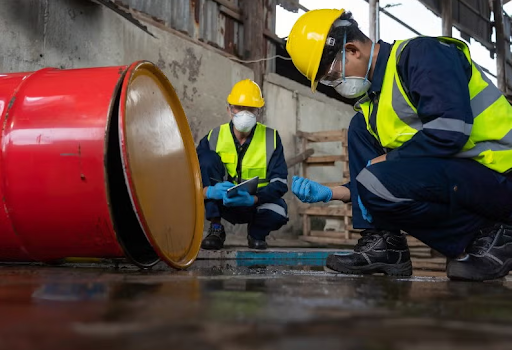
There is a pattern that repeats on worksites more often than safety managers care to acknowledge. A spill happens, someone mops it up, the incident gets logged as minor, and everyone moves on. Then it happens again. A little worse each time, a little closer to something that matters. The issue was never really the spill. It was the absence of anything resembling a real system behind it. Emergency spill response, when it is actually built with intention, is what stops that cycle from running indefinitely.
Speed Without Direction Fails
The instinct to move fast when something spills is correct. But speed without knowledge tends to compound the problem rather than contain it. A worker who grabs the wrong absorbent for a solvent, or who wades into a chemical spill without appropriate protection, has not helped — they have created a second incident on top of the first. What sites actually need is trained speed. The kind where workers already know what the substance is, what it reacts with, and which response is appropriate before the adrenaline kicks in. Moving quickly in the wrong direction is not a response. It is a liability dressed up as one.
Most Sites Misjudge Their Readiness
Ask almost any safety manager whether their site has a spill response plan, and they will say yes without hesitation. Then ask whether staff can find the kits under pressure, whether the absorbents on hand match the chemicals actually in use, or when the plan was last reviewed. The answers tend to soften considerably. Emergency spill response readiness is not measured by what lives in a folder on a shared drive. It is measured by what happens in the first moments of a real incident — and for many sites, those first moments are considerably messier than the plan suggests they should be.
Drains Turn Small Spills Into Serious Ones
A spill that stays on the floor is a clean-up task. A spill that reaches a stormwater drain is something else entirely — an environmental incident with consequences that do not resolve themselves once the water disperses. Many sites focus their planning on large, dramatic events and quietly overlook the everyday risk of smaller spills near drainage points. Workshop floors, loading docks, and outdoor storage areas sit closest to that risk. Solid containment planning starts with drainage, not volume. It maps where the drains are, identifies which areas sit nearest to them, and positions barriers and covers accordingly — before anything goes wrong, not after.
Kit Contents Are Rarely Reviewed
Spill kits get purchased, positioned, and largely forgotten. The problem is that chemical inventories change. A kit assembled to suit what was on site previously may not suit what is there now. Clay-based absorbents handle oils reasonably well but perform poorly on aggressive solvents. Some materials react with specific substances and introduce new hazards mid-clean-up. None of this is hidden information — it sits in the safety data sheets that sites are already required to maintain. The gap is not knowledge. It is the habit of revisiting kit contents as the site evolves, rather than assuming that what was correct once remains correct indefinitely.
Incident Reports Are Actually Data
Post-spill documentation tends to be treated as a compliance exercise. Fill in the form, file it away, move on. But those reports, read together over time, reveal patterns that individual incidents do not. The same area appears repeatedly. The same substance. The same part of the shift. Those patterns point at something structural — a valve that keeps getting temporarily patched, a workflow that creates unnecessary transfer risk, or a storage arrangement that has quietly outgrown its space. Sites that read their incident history as operational data tend to see spill frequency fall over time, because they are addressing the conditions that produce spills rather than just cleaning them up.
Conclusion
The sites that handle spills well are not fortunate. They have done the work beforehand. Emergency spill response is a practised capability, not a purchased product, and the difference between the two shows up clearly when something actually goes wrong. Real readiness means kits matched to current chemicals, staff who know what to do without consulting a poster, and drainage risks mapped before they become incidents. That kind of preparation does not happen by itself. It is built deliberately — and it is what separates a contained situation from a serious one.
